


Your employees are complaining about headaches, eye strain and declining concentration — even though the room seems bright enough? There’s a good chance the answer is hanging right above their heads.
Cheap LED panels deliver light — just not the right kind. And at a modern office computer workstation, that difference is everything. According to a Staples study, 31 % of German office workers find their office lighting uncomfortable — while 80 % consider good lighting important for their work performance.
This guide explains why standard LED panels systematically fail at computer workstations, what minimum technical requirements apply — and which models actually meet those requirements.
What sets computer workstations apart from ordinary workplaces
A warehouse just needs enough light for workers to move around safely. A computer workstation is a different story: here the eye works simultaneously on a lit work surface, a self-illuminated monitor and light sources coming in from different angles — for hours, every single day. This difference is clearly defined in European standards and German employment law.
Requirements from DIN EN 12464-1 and ASR A3.4
DIN EN 12464-1:2021-11, read together with the Workplace Rule ASR A3.4, sets the following minimum requirements for computer workstations:
| Parameter | Minimum Requirement |
|---|---|
| Illuminance (Em) | ≥ 500 lux on the work surface |
| Glare limitation (UGR) | ≤ 19 |
| Color rendering (Ra) | ≥ 80 |
| Uniformity (Emin/Eavg) | ≥ 0.6 |
Why glare at the monitor is doubly harmful
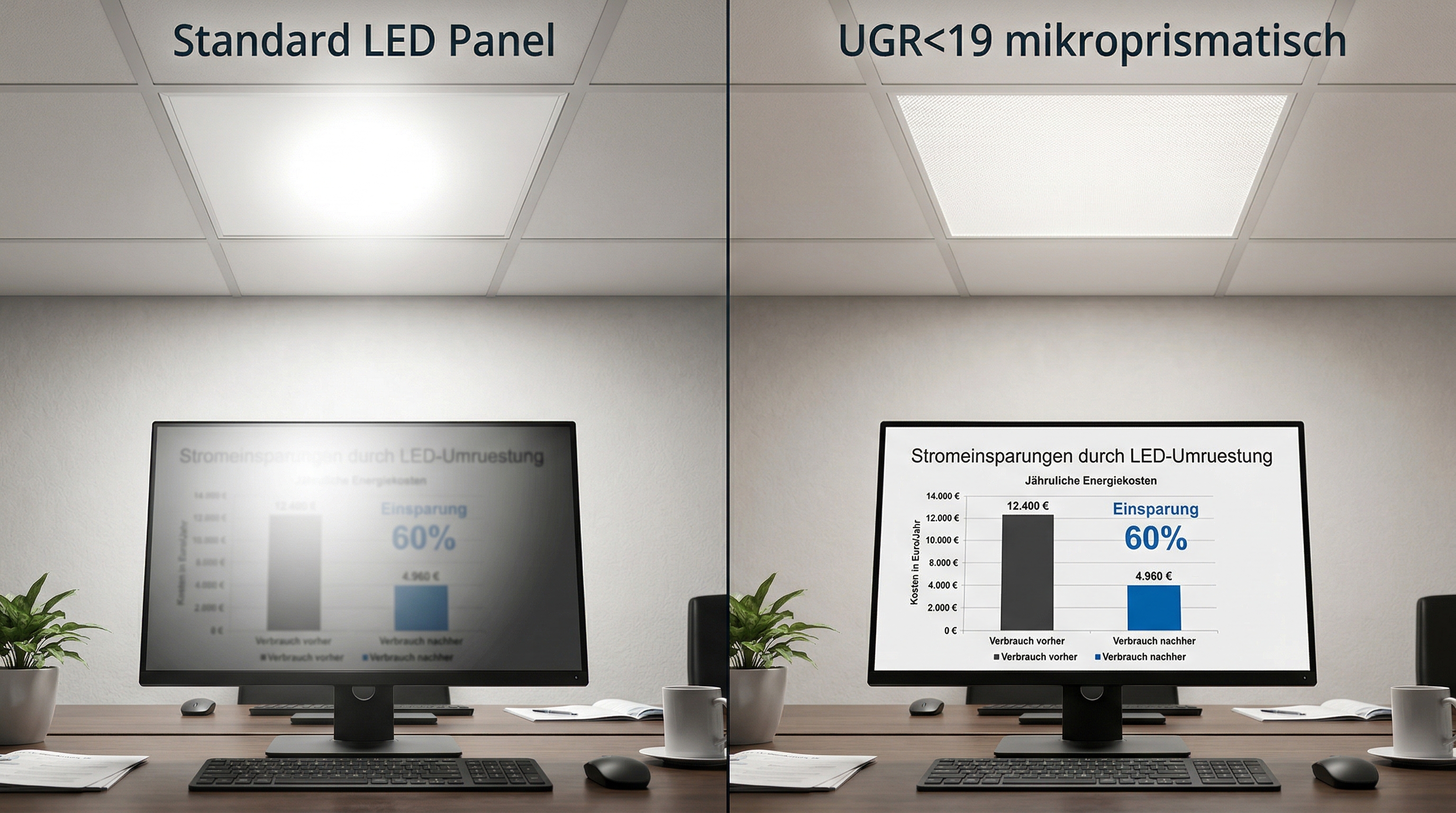
At a computer workstation there are two types of glare that reinforce each other: Direct glare occurs when a luminaire shines too brightly and hits the eye directly. Reflected glare occurs when the luminaire’s image reflects off the screen.
The BAuA study F2353-4b shows that lighting conditions account for up to 30 % of the variability in visual fatigue. The permitted luminance under the standard is ≤ 1,000 cd/m² at angles above 65°. A cheap LED panel without proper optics can easily reach 3,000 to 5,000 cd/m².
The 5 most common mistakes with cheap LED panels
Cheap LED panels often look perfectly fine on paper. In real-world use, though, it’s a different story. Here are the five mistakes that show up most often in practice.
No UGR < 19 — no real glare protection
Many cheap models are marketed as “suitable for offices” without even mentioning a UGR value. A panel without microprismatic optics simply can’t limit luminance at the critical angle (> 65°). The result: the luminaire image reflects in the monitor, employees unconsciously lean in closer — and still get tired anyway.
Flicker — invisible, but bad for your health
Household current delivers 50 Hz AC power. A cheap driver passes the 100 Hz ripple straight to the LEDs — the light flickers. Cheap panels can reach modulation values of 25–90 %. Headache risks at 100 Hz with modulation above 35 % are well documented. Since 1 September 2021, EU Regulation 2019/2020 has made it mandatory: PstLM ≤ 1.0 and SVM ≤ 0.4. Many cheap imports don’t meet this requirement.
Poor CRI — your eyes pick up the slack
Many cheap panels claim Ra 80 but deliver Ra 70–75 in reality. The brain constantly tries to compensate for color distortions. After eight hours of exposure, this “color correction effort” adds real strain — employees end up more tired without knowing why.
Wrong color temperature
Cheap panels are often sold at 6,000 K because the higher color temperature gives the impression of brighter light. For office workstations, this is counterproductive: 6,000 K suppresses melatonin roughly twice as much as 4,000 K and disrupts the circadian rhythm by around 3 hours (Harvard research).
PS plastic instead of PMMA — yellowing within a few years
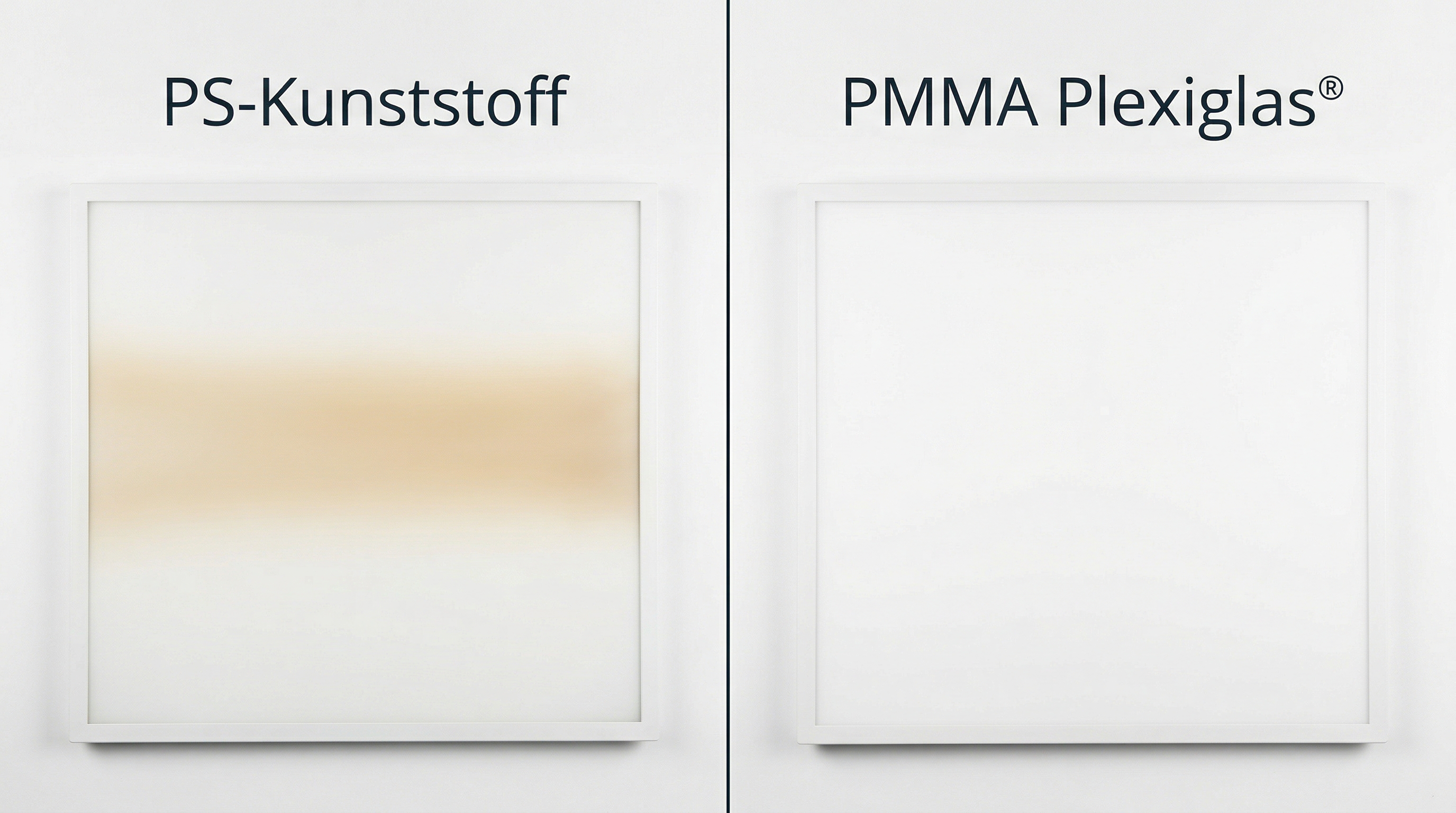
Cheap LED panels often use a diffuser made from basic polystyrene (PS). PS is inexpensive, but it yellows noticeably under UV exposure and operating heat within just a few years — the light gets more yellowish, the ceiling looks neglected even though the fixture technically still works.
Quality panels use PMMA (polymethyl methacrylate, brand name: Plexiglas®) instead. PMMA is significantly more UV-stable, keeps its clarity even after years of continuous operation and still looks freshly installed after a decade. A panel that yellows after three years isn’t a bargain — it’s a hidden cost.
What makes a good LED panel for the office
A quality office LED panel with UGR19 must meet four technical criteria simultaneously. Ignore even one of them and you don’t have an office panel — you have a cheap fixture for somewhere that isn’t very demanding.
UGR < 19
Microprismatic grid or high-quality opal diffuser optics. Reliably keeps luminance at angles above 65° below the limit.
Flicker-Free
High-quality driver (e.g. Mean Well) with < 1 % modulation. Compliant with EU Regulation 2019/2020.
CRI ≥ 85
Ra 80 is the legal minimum. Ra ≥ 85 measurably reduces the compensatory work your eyes have to do.
4,000 K
Equivalent to morning daylight — supports concentration without disrupting your sleep schedule.
Our go-to panels for offices & commercial spaces
For facility managers and office outfitters looking for standard-compliant LED panels for computer workstations, cologne-led.de carries four proven models that tick every mandatory box and hold up in daily use.
LED Panel 62×62 cm — The Classic Grid Format
The standard format for the most common type of suspended grid ceiling found in German offices and administrative buildings.
| Property | Value |
|---|---|
| Format | 62 × 62 cm |
| Wattage | 36 W |
| Luminous flux | 4,600 lm |
| Color rendering | Ra 85 |
| Color temperature | 4,000 K |
| UGR | < 19 |
| Flicker | flicker-free |
Ideal for: Offices with suspended grid ceilings in the 62×62 cm format, open-plan spaces, conference rooms and administrative buildings.
LED Panel 120×30 Office Workstation UGR19 — 36 W, 4,200 lm
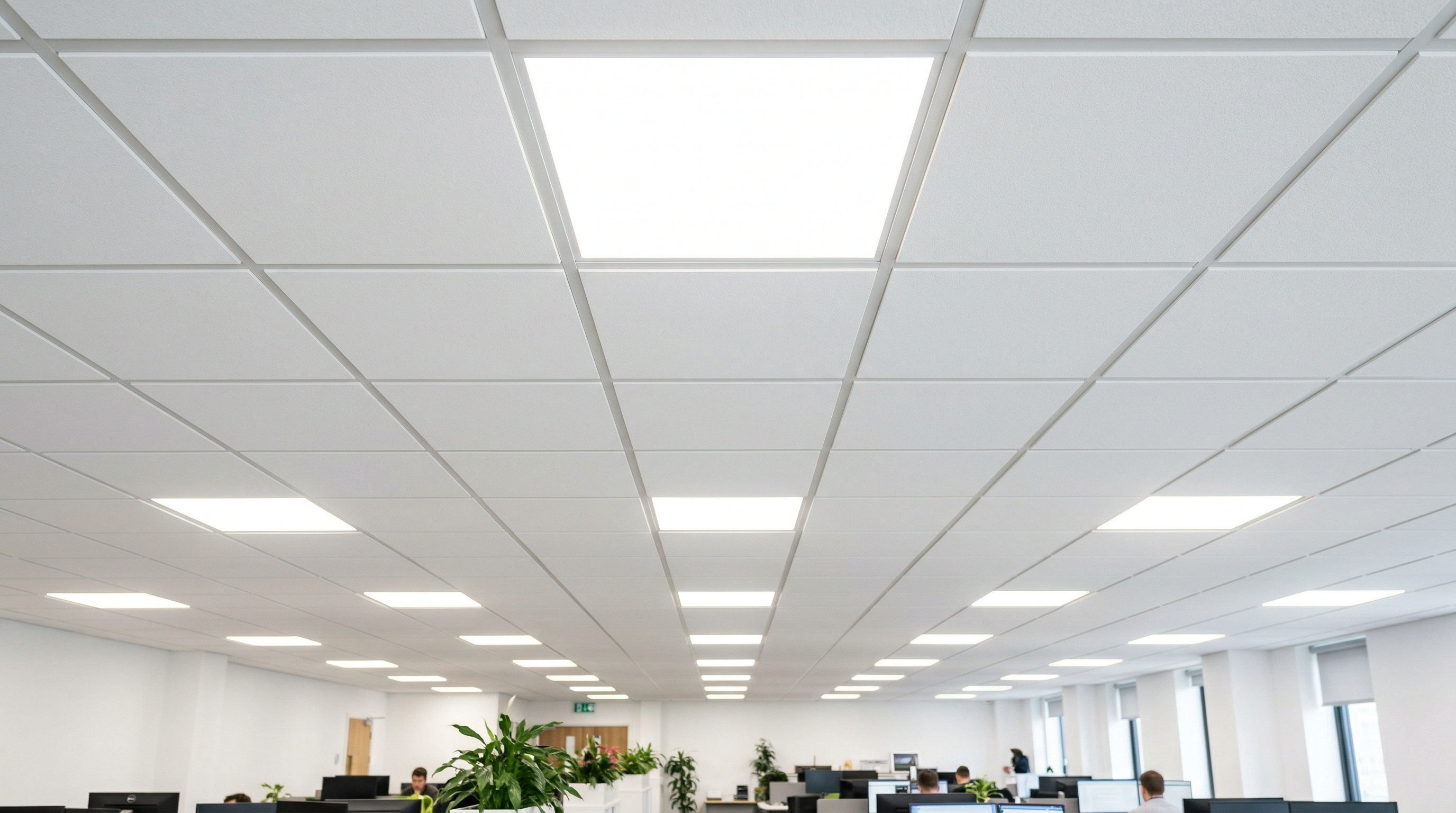
The most popular model for linear ceiling systems and modern offices. TÜV/GS certified, standard-compliant and ready to ship.
| Property | Value |
|---|---|
| Format | 120 × 30 cm |
| Wattage | 36 W |
| Luminous flux | 4,200 lm |
| Color rendering | Ra 85 |
| Color temperature | 4,000 K |
| UGR | < 19 |
| Flicker | flicker-free (< 1 % modulation) |
| Certification | TÜV/GS certified |
The TÜV certification verifies the declared values for flicker-free operation and UGR under real operating conditions — a quality mark that imported products without independent testing simply can’t offer.
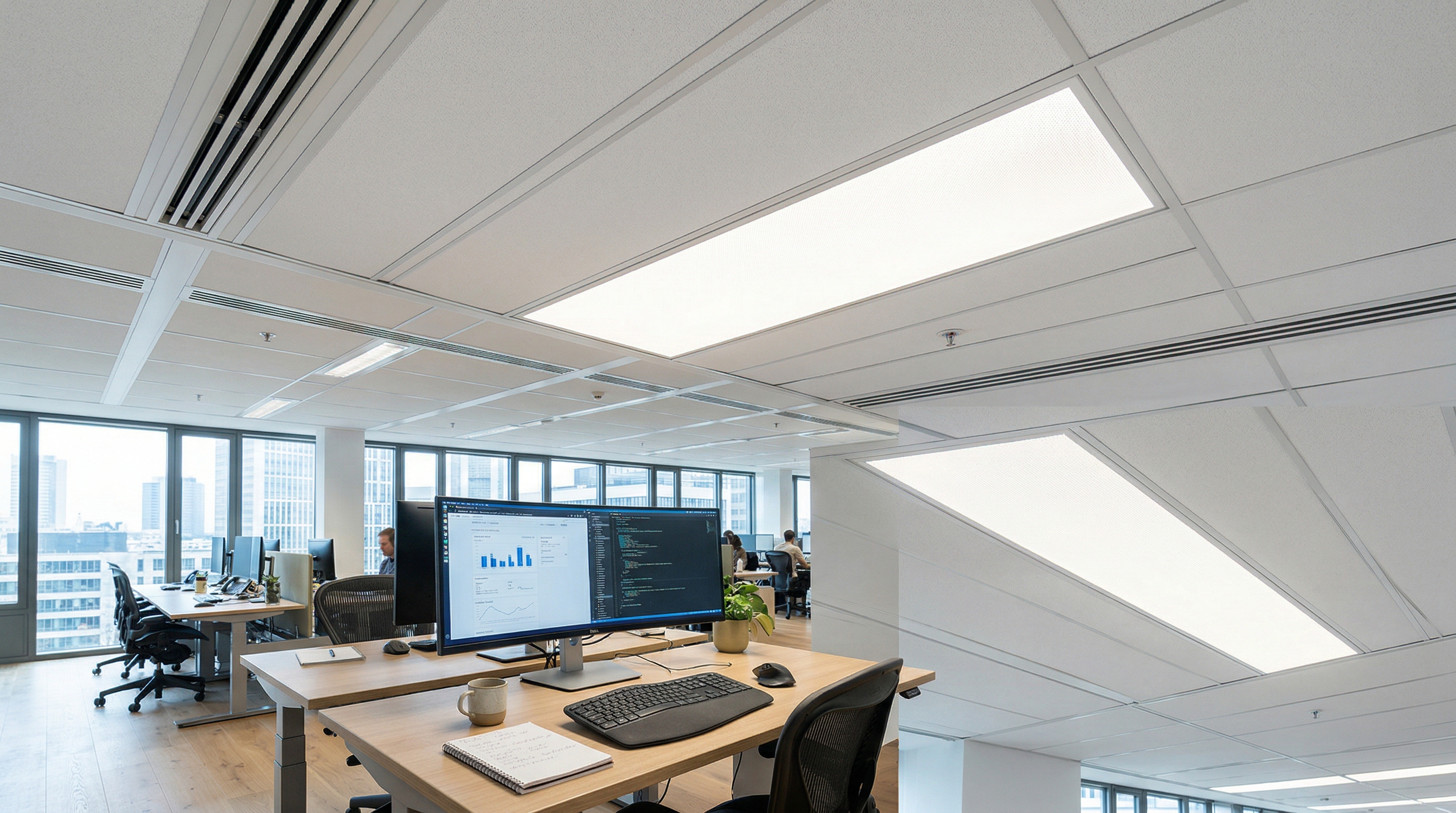
Premium Frameless Recessed LED Panel 62×62 cm
The borderless version for high-end office spaces and prestige rooms where aesthetics matter just as much as performance.
| Property | Value |
|---|---|
| Format | 62 × 62 cm |
| Wattage | 40 W |
| Luminous flux | 4,200–4,500 lm |
| Color rendering | Ra 94–95 |
| Color temperature | 3,000 K / 3,500 K / 4,000 K (selectable) |
| UGR | < 19 |
| Design | frameless, flush-mount |
| Flicker | flicker-free |
Ideal for: Reception areas, executive offices, meeting rooms and showrooms where a clean, frameless ceiling finish is required.
→ View Premium Frameless Panel 62×62

LED Ceiling Light — Reception, Lounge & Customer Areas
Not every part of an office or commercial building has a standard grid ceiling. For reception zones, waiting areas and customer rooms, this ceiling light delivers premium light quality in a striking design.
| Property | Value |
|---|---|
| Type | LED Ceiling Light, 120 × 30 cm |
| Wattage | 40 W |
| Luminous flux | 4,200–4,500 lm |
| Color rendering | Ra 94–95 |
| Color temperature | 3,000 K / 3,500 K / 4,000 K (selectable) |
| UGR | < 19 |
| Flicker | flicker-free |
Ideal for: Reception areas, lounges, waiting rooms, retail spaces and any commercial space without a grid ceiling where light quality and looks both need to impress.
Standards and legal requirements — what employers need to know
For B2B decision-makers, the question of lighting isn’t just about comfort. It’s a liability issue.
The legal chain: ArbStättV → ASR A3.4 → risk assessment
The Workplace Ordinance (ArbStättV) requires employers to provide suitable lighting at workplaces. The specifics are laid out in Workplace Rule ASR A3.4, which references DIN EN 12464-1. The risk assessment required under ArbStättV § 3 must explicitly include the lighting situation.
EU product law: what applies to all panels
Since 1 September 2021, EU Regulation 2019/2020 has made the following mandatory for all indoor LEDs:
- Flicker metric PstLM ≤ 1.0
- Stroboscopic visibility measure SVM ≤ 0.4
- Color rendering Ra > 80 (EU Regulation 1194/2012)
Products that don’t meet these values aren’t legally allowed on the EU market. Yet non-compliant imports continue to circulate. Anyone who insists on TÜV test reports and CE declarations of conformity with test protocols is on the safe side.
Practical advice for the risk assessment
When sourcing equipment, document the following:
- UGR value of the panel (< 19 for computer workstations)
- Flicker test protocol (PstLM ≤ 1.0, Percent Flicker < 3 %)
- CRI measurement (Ra ≥ 80, ideally ≥ 85)
- Color temperature (4,000 K recommended)
- Independent certification (TÜV, GS or equivalent EU testing body)
Our expertise: over 10 years of office lighting
Cologne LED has been advising facility managers, architects and office outfitters on standard-compliant lighting for over a decade.
Our lighting experts know the requirements of DIN EN 12464-1 and ASR A3.4 from real-world experience: from the initial risk assessment right through to final sign-off by the occupational health authority.
All products in our UGR19 range have been tested under real office conditions — not just in a lab. TÜV/GS certificates are available for all premium models.

Frequently Asked Questions (FAQ)
What does UGR19 mean in practice?
UGR 19 is the maximum glare value required by the standard for computer workstations. A panel with UGR < 19 limits luminance at shallow angles (from 65° onwards) so that neither direct nor reflected glare impairs vision or concentration. UGR 19 is the minimum standard — not the quality goal. At UGR 19, around 35 % of observers still find the glare noticeable.
Is Ra 80 enough or do I need Ra 85 for offices?
Ra 80 is the legal minimum. For offices with intensive screen work we recommend Ra ≥ 85, because at lower CRI the eye constantly compensates for color distortions — which measurably contributes to fatigue. For graphic design, architecture or other color-critical work, Ra ≥ 90 or Ra 97 should be the standard.
Can LED panels really cause headaches?
Yes. Flickering LEDs with high modulation at 100 Hz can cause headaches, eye strain and concentration problems — even when the flicker isn’t directly visible to the eye. This is well documented in occupational health literature. Quality panels with an active driver and PstLM < 1.0 eliminate this risk entirely.
Does UGR19 only apply to open-plan offices or individual offices too?
The requirement applies to every computer workstation under the Workplace Ordinance (ArbStättV) — regardless of room size. UGR ≤ 19 applies in individual offices, company home-office setups and meeting rooms with a fixed PC workstation too.
Conclusion and next steps
An LED panel for the office isn’t a commodity decision. At computer workstations where employees spend eight hours a day under artificial light, lighting quality has a direct impact on productivity — and it’s legally binding.
The four core criteria for a standard-compliant office panel are clear: UGR < 19, flicker-free, CRI ≥ 85, 4,000 K. Take these requirements seriously and you protect your employees’ health, meet your ArbStättV obligations and invest in lighting that works reliably for years with minimal maintenance.
Find the right office panel now
All models TÜV-certified, standard-compliant and ready to ship. Free advice for facility managers and architects.
All UGR19 Panels 120×30 Office Panel Premium Frameless 62×62