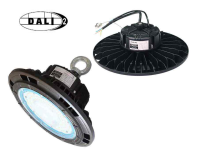
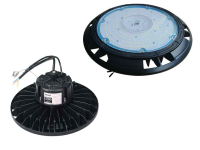
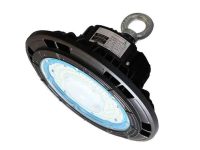
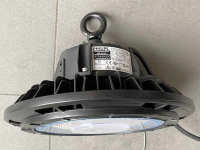
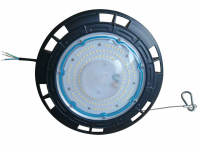
LED high bay lighting for workshops, warehouses and showrooms
Anyone replacing old mercury vapour, metal halide or sodium floodlights with LED high bay lights usually needs only a third of the electricity for the same building. Which fitting suits you depends on the mounting height, the work below it and the illuminance you need.
We have been converting industrial buildings to LED since 2014, mainly in production, logistics and warehousing, in sports halls, event spaces and large buildings such as gyms. Here you will find the key planning figures, a calculator for your own building and three of those projects.
Greving Landtechnik, Wesseling: showroom after the conversion to LED high bay lights
Where LED high bay lighting is used
The requirements differ less by industry than by the task and the surroundings. These six cases cover most of our projects.
Industrial buildings and production
In industry, high bay lighting sits above assembly, machining and quality control. The finer the work, the more light is needed and the more important it is to keep glare in check. For fine assembly and quality control we plan with 500 lx and above.
Workshops, vehicle repair and paint shops
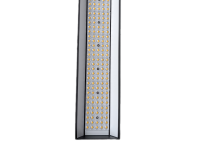
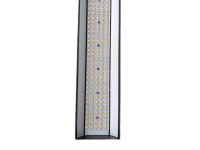
Work happens on and under the vehicle, often on a lift. What counts here is even light without hard shadows, frequently from continuous lines above the working bays rather than from single floodlights. Below 4 m, batten luminaires are a robust alternative. Important where paintwork is involved: avoid fittings with visible individual LEDs, that is continuous lines or LED tubes with a dotted light pattern. Those dots reflect in the paint and hide exactly what you are looking for, namely unevenness and colour transitions. A fully matt diffuser that reflects as an even surface is the better choice, together with high colour rendering.
Warehousing and logistics
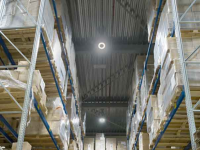
Racking aisles, order picking, dispatch. In the aisles, the vertical illuminance on the racking matters more than the figure on the floor. For traffic routes used by forklifts we recommend 150 to 200 lx. Because nobody works in aisles and side areas for hours at a time, this is where control pays off most: use the daylight from roof lights and add motion or presence detectors per aisle. The light then runs only when somebody is there. How that is done is covered in the section on DALI.
Agriculture, machinery sheds and livestock buildings
Here the lighting has to cope with dust, moisture and cleaning with a pressure washer, which calls for a suitable IP and IK rating. In livestock buildings there is ammonia in the air as well, and it attacks the housing. Versions with an ammonia-resistant diffuser are available for that; without them the diffusers go cloudy or brittle over time. Animal areas add requirements for flicker-free and dimmable light, which we clarify project by project.
Showrooms and exhibition spaces
Here the light works on the goods. We plan with 300 lx, look for colour rendering of CRI 80 and above, and keep the appearance calm, with no glaring points of light above customers' heads.
Sports and training halls
In many exercises people look upwards, so low-glare fittings and positions outside the lines of sight come first, along with impact resistance against balls. For the light itself the opposite of cosy applies: a training space should feel activating, so neutral white or cool white and bright enough, not the warm mood of a living room.
What the conversion saves
Old discharge lamps use more than the figure printed on the lamp, because the ballast draws power as well. On a 400 W lamp that is roughly another 50 W. With those figures the comparison looks like this:
Mercury or metal halide 400 Wagainst a 150 W LED high bay
450 W150 W
−67 %
Metal halide 250 Wagainst a 100 W LED high bay
280 W100 W
−64 %
Continuous line 2 × T8 58 W, magnetic ballastagainst an 80 W LED line
140 W80 W
−43 %
Power per fitting including ballast. T8 figures follow EU Directive 2000/55/EC (class C); discharge lamps are calculated with around 12.5 % for the ballast.
Maintenance comes on top. Depending on the type, discharge lamps have to be replaced after roughly 8,000 to 12,000 operating hours. In tall buildings that means an access platform, an electrician and often an interruption to production every time. LED high bay lights run considerably longer; the exact service life is given in the data sheet of each fitting.
Work out what a conversion saves in your building
Enter the number of fittings, what is installed today, the operating hours and your electricity price. The calculator shows the annual saving, the reduction in consumption and the payback over eight years.
Which type of fitting suits your building?
The mounting height decides the beam angle. Wide-beam fittings spread the light evenly in low buildings; in tall ones too little of it reaches the floor.
Type
Mounting height
Beam angle
Typical use
Power
UFO high bay
4–8 m
90–120°
Warehousing, production, workshops
100–240 W
Deep beam high bay
8–15 m
60–90°
Tall production halls, logistics
150–240 W
Continuous line, linear high bay
3–8 m
120°
Racking aisles, production lines
40–80 W per segment
Weatherproof batten luminaire
3–4.5 m
120°
Low buildings, wash bays, cold stores, car parks
20–60 W
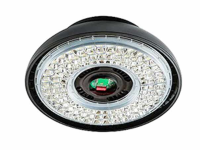
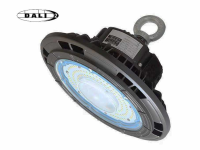
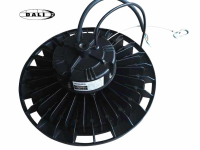
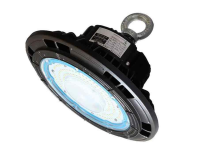
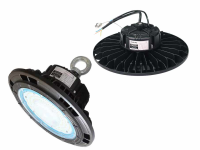
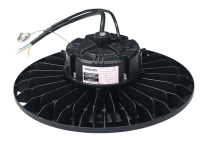
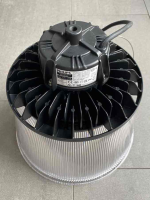
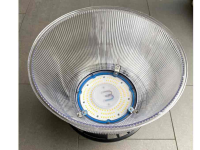
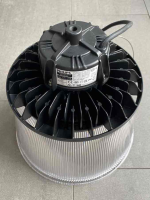
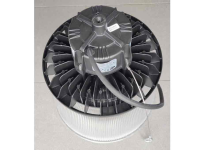
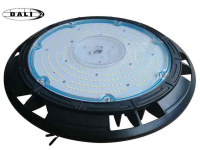
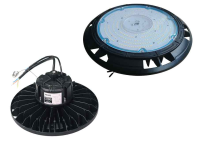
UFO high bay lights for 4 to 8 metres
The round, flat shape is the most common choice for warehouses and workshops. Which output you need depends above all on the work going on underneath.
Above 8 m, deep beam fittings concentrate the light with a reflector and a 60 to 90° beam angle so that enough of it reaches the floor. As a rough guide for a 10 m height and 250 m² of floor area:
Warehouse with staff
200 lx · 200 W deep beam, 60°
Area per fitting
approx. 35 m²
Number
6–7 fittings
Order picking, assembly
300 lx · 200 W deep beam, 60°
Area per fitting
approx. 25 m²
Number
9–10 fittings
Walls, floor, racking and machinery change the result considerably. These figures are no substitute for planning the actual building.
Rule of thumb for a quick estimate: luminous flux needed in lumens = illuminance in lux × area in m² ÷ the efficiency of the installation. For buildings with light-coloured walls and suitable optics, that efficiency is roughly between 0.6 and 0.8. Example: 300 lx over 250 m² at 0.7 gives around 107,000 lm, so about four to five fittings of 25,000 lm.
Continuous lines: industrial buildings, workshops and long racking aisles
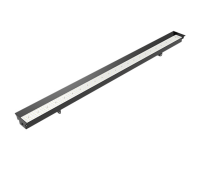
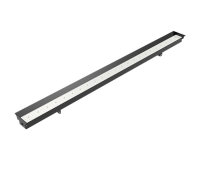
A continuous line is an unbroken row of segments, usually 1.5 m long with 40 to 80 W each. In an industrial building it is mounted above racking aisles, production lines or workbenches. The advantage over single floodlights is that the light comes from a long line instead of a few points, so shadows fall more softly, which makes the difference at machines and in racking aisles.
Continuous lines suit mounting heights of roughly 3 to 8 m and can be dimmed and switched in groups as a DALI version. How much a conversion from T8 fluorescent tubes to an LED line saves is worked out by the calculator with its profile for continuous lines. There is an example from practice in the projects. The fittings for it are in the category LED linear luminaires.
Weatherproof batten luminaires for low buildings up to 4 metres
Where ceilings are low, the classic batten luminaire is often the better fitting than a high bay. Up to about 4 m a single-lamp version is enough; up to roughly 4.5 m a twin-lamp version works well. Above that, the wide beam angle puts too much light on the walls, and UFO or deep beam fittings are the better choice.
Their strength is the environment: a sealed housing, IP65, unaffected by dust, moisture and cleaning. Typical places are wash bays, cold rooms, workshops, low-ceilinged stores, car parks and basements. Because the light comes from a long surface rather than a single point, they glare less at low mounting heights than a floodlight of the same output.
Glare is one of the most common problems with LED high bay lighting. It mainly arises when you look into the fitting from the side.
What matters is not how much light goes downwards, but how bright the fitting appears at shallow viewing angles. Anyone looking across the building, reaching up at the racking or following a load on a crane has the fittings at an angle in their field of view. The wider the beam angle, the more light the fitting sends in exactly that direction. Optics that guide the light tightly downwards, or a shield that covers the LEDs at shallow angles, therefore work better against glare than any other measure.
The size of the luminous surface counts as well. Many UFO high bays push 20,000 lumens and more through a small, clear diffuser. The same luminous flux spread over a large matt surface looks calmer to the eye, because the luminance is lower.
Glare tires people, causes mistakes and can lead to accidents where vehicles are moving. The European standard EN 12464-1 sets glare limits for indoor work places. In Germany the workplace rule ASR A3.4 applies on top: section 6.3 requires disturbing glare to be minimised and glare that could cause accidents to be avoided.
Made with AISame luminous flux, different effect: with a wide beam angle the eye looks straight at the LEDs from shallow angles. Tighter optics with a shield direct the light downwards. Schematic illustration, made with AI, not to scale.
UGR: what the figure tells you and what it does not
UGR (Unified Glare Rating) rates psychological direct glare. The lower the figure, the less the installation glares; the steps are 16, 19, 22, 25 and 28. One thing matters here: UGR is not purely a property of the fitting. It also depends on room size, mounting height, the reflectance of ceiling, walls and floor, and on where the observer stands and looks. A figure from a data sheet applies to a reference room and can differ in your building. Which limit applies to a given task is set out in EN 12464-1.
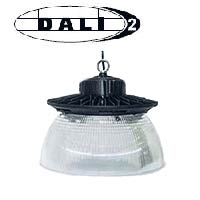
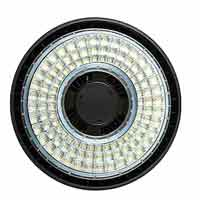
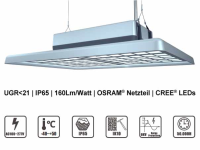
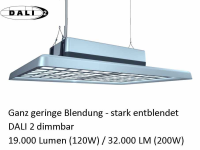
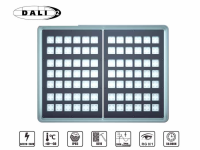
Two of our high bay fittings are designed for low glare; the manufacturer states a UGR below 24 for both. For a high bay that is a good figure:
When putting away and picking loads, the driver looks up along the mast, exactly where the fittings hang above the racking.
Pallet trucks and order pickers
Anyone reversing or reaching into upper shelves keeps looking up towards the roof.
Crane operations
Crane drivers and slingers follow the load at height, which is the level of the lighting.
Sports and training halls
During floor exercises or work on rings and pull-up bars the gaze naturally goes to the ceiling.
What helps against glare
A larger light emitting surface
Flat high bays with a large matt or prismatic diffuser spread the same luminous flux over more area. The building does not get darker, but the fitting looks noticeably calmer.
Reflector or glare shield
A shield covers the LEDs at shallow viewing angles. That helps above all when looking across the building from a distance.
Tighter optics instead of a wide beam
The most effective measure: optics of 60 to 90° guide the light downwards instead of sending it sideways into the eye. Wide 120° fittings are the most frequent cause of glare in low buildings with long sight lines.
Sensible fitting layout
Do not place fittings directly above forklift routes or the crane runway; offset them to the side or run them parallel to the routes. More fittings at lower output glare less than a few very powerful ones.
Low-glare high bay with a matt diffuser in a CrossFit gym, more in the projects.
Lighting control and dimming with DALI
With DALI every fitting can be addressed individually, dimmed and switched in groups. In industrial buildings that brings three things above all: the lighting dims down when daylight comes through roof lights or saw-tooth roofs, traffic routes dim when nobody is driving, and break areas switch themselves off.
For new installations we recommend DALI-2. The standard is tested across manufacturers and offers better diagnostics. How much electricity the control saves on top depends heavily on daylight and occupancy; a blanket figure would be guesswork.
DALI dimming without cabling
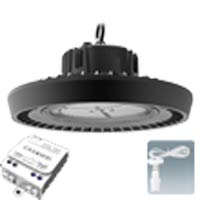
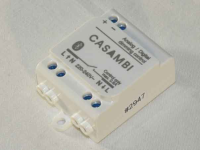
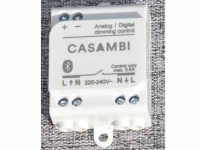
In existing buildings, the control cable to every fitting is often the most expensive part of the job. The wireless option removes it: the fittings get a radio adapter and form a network among themselves. Dimming, groups and sensors work as they do with wired DALI. That makes it possible to retrofit control in high-bay warehouses or in production halls that keep running, and to extend it later.
Cologne LED has already delivered many projects with DALI, KNX and building automation. Talk to us about which solution suits your building.
Illuminance table for industrial buildings by task
How bright a building has to be is set out in EN 12464-1, and in Germany additionally in the workplace rule ASR A3.4, whose minimum values are listed in its annex 3. The lux figure gives you the luminous flux that should be installed per square metre. For traffic routes with vehicles we recommend more light than the minimum.
Area
Illuminance
Luminous flux per m² (3–4 m height)
UGR
Routes with forklifts, pallet trucks, cranes
150–200 lx our recommendation
approx. 190–250 lm/m²
–
Warehouse with permanent staff
200 lx
approx. 250 lm/m²
≤ 25
Order picking, rough assembly
300 lx
approx. 380 lm/m²
≤ 25
Showroom
300 lx
approx. 380 lm/m²
≤ 22
Fine assembly
from 500 lx, depending on detail
from approx. 625 lm/m²
≤ 19
Quality control
from 500 lx
from approx. 625 lm/m²
≤ 19
Electronics, precision engineering
500–1,000 lx
approx. 625–1,250 lm/m²
≤ 19
The lumen figures include the usual losses from distribution, reflection and ageing. For heights above 5 m or dark walls and floors, allow 20 to 30 % more. UGR is the glare figure: the lower it is, the less glare.
From one of our projects: planning a vehicle wash bay in DIALux evo. On the left the layout of the fittings, on the right the calculated illuminance across the area.
Three worked examples
Warehouse
500 m² · 6 m high · 200 lx
Required
125,000 lm
Fittings
7–8 × 150 W
Installed (21,000 lm each)
147,000–168,000 lm
Production hall
800 m² · 8 m high · 300 lx
Required
304,000 lm
Fittings
11–13 × 200 W
Installed (29,000 lm each)
319,000–377,000 lm
High-bay warehouse
1,000 m² · 12 m high · 300 lx
Required incl. height allowance
450,000 lm
Fittings
13–15 × 240 W deep beam
Installed (36,000 lm each)
468,000–540,000 lm
Calculated with the lower luminous flux of each wattage class and some reserve for ageing and dirt. In a high-bay warehouse the racking casts shadows, so it is worth matching the fitting positions to the layout.
Protection ratings for harsh environments
The IP rating describes how well a fitting is sealed against dust and water. The IK rating states how much impact it withstands, for example from a forklift or flying parts.
Rating
Meaning
Typical locations
IP54
Dust protected, protected against splashing water
Dry production, workshops, stores without wet cleaning
IP65
Dust tight, protected against water jets
Food businesses, cold stores, car parks, agricultural buildings
IP66
Dust tight, protected against powerful water jets
Wash bays, intensive wet cleaning, chemical plants
The colour temperature influences how focused and how comfortable people feel in the building. For most working areas, neutral white is the right choice.
4000 KNeutral white
The standard for production, warehousing and workshops. Looks neither yellowish nor bluish.
5000–6000 KDaylight white
More contrast for fine assembly and quality control. Tiring over large areas, sensible at individual inspection stations.
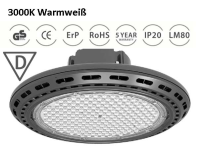
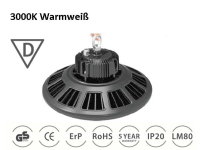
3000 KWarm white
Less usual, but increasingly asked for: for buildings with visitors such as showrooms and exhibition spaces, event halls, riding arenas or gyms. Rare on high bay fittings, available from us on request.
Colour rendering (CRI) shows how natural colours appear. CRI 80 is enough for warehousing, logistics and assembly. Where colours are judged, for example in paint shops, printing, textiles or food processing, it should be CRI 90 or higher.
Projects from practice
Greving Landtechnik, Wesseling
Showroom · LED UFO high bays
The old lighting used a lot of electricity and made the machines look rather flat. The new high bays hang from the existing mounting points, so the light positions stayed as they were. No work on the roof structure was needed and the shop kept trading.
With the higher-contrast light, the paint, the details and the finish of the machines are easier to see.
Electricity use
approx. 50–60 % lower (expected)
Brightness
approx. 20 % higher
Installation
existing suspension reused
Workshop with machine tools
Production hall · LED continuous line
Two continuous lines hang on chains along the rows of machines. The light spreads over the full length of the building without bright islands, and it stays even between the machines as well. During the day there is extra light through the roof lights.
Before that, cheap high bays bought online were mounted here and failed roughly every six months. When one went out, a large part of the building was poorly lit straight away. In a continuous line with T8 tubes, a single failed tube hardly matters, and staff can replace it themselves in no time.
CrossFit gym
Sports hall · low-glare high bays
Training on the floor, on rings or on pull-up bars means athletes often look straight up. That is why we used flat high bays with a matt, low-glare diffuser. They sit on a truss below the roof and light the training area without anyone looking into harsh LED points.
Common planning mistakes
We keep seeing these four mistakes in existing buildings. All of them can be avoided with a little planning before buying.
1
A few very bright fittings instead of many medium ones
Problem
Six 240 W fittings save mounting points, but they create bright islands and dark gaps. Directly underneath there are 500 to 800 lx, in between less than 100 lx. Forklift drivers are dazzled while manoeuvring, and EN 12464-1 requires a uniformity of at least 0.6.
Better
More fittings at medium output, for example ten 150 W units instead of six 240 W ones. The cost is similar, the light is more even and it glares less.
Continuous LED lines above the rows of machines: even light without bright islands. More about it in the projects.
2
Cheap high bays without evidence
Problem
Cheap fittings often deliver only 100 lm/W instead of 130 to 150 lm/W, so around a third less light for the same electricity. Weak drivers fail early, and the colour temperature shifts after a year or two. In tall buildings every replacement gets expensive. There is an example in the projects: in that workshop, fittings like these failed roughly every six months.
Better
Look at luminous efficacy (at least 130 lm/W), LM-80 test reports, an L70 figure above 50,000 hours and the warranty period. The extra cost comes back through service life and electricity use.
3
Full light around the clock in the warehouse
Problem
In many warehouses the light runs continuously at full output although whole aisles stay empty for hours.
Better
Presence detectors with dimmable fittings: a base level of 20 to 30 % in empty areas, full output as soon as a forklift or a person arrives, and back down after a few minutes of run-on. Dimming is gentler on the fittings than frequent switching.
4
The same brightness everywhere
Problem
If the whole building is planned to a single figure, some areas get more light than they need while assembly or inspection stations get too little. Traffic routes with vehicles need 150 to 200 lx, order picking 300 lx, quality control from 500 lx.
Better
Divide the building into zones by visual task, adjust the density of fittings per zone and switch the zones separately or control them via DALI.
Frequently asked questions
Which high bay suits which mounting height?
UFO high bays with 90 to 120° suit 4 to 8 m. Deep beam fittings with a reflector and 60 to 90° are meant for 8 to 15 m. In low buildings up to about 4 m, linear fittings or weatherproof batten luminaires are often the better choice, up to 4.5 m in the twin-lamp version.
How many high bay lights do I need per square metre?
That depends on the illuminance, the mounting height and the output of the fitting. As a guide for 6 m and 200 lx: one 150 W UFO high bay with 21,000 to 28,000 lm covers roughly 35 to 40 m². We are happy to go through your own building with you.
Can I dim LED high bay lights with an ordinary dimmer?
No. High bay lights are dimmed via DALI or 0–10 V. A trailing-edge dimmer causes flicker and can damage the electronics. DALI also offers individual addressing, scenes and diagnostics.
Are LED high bay lights suitable for damp areas and wash bays?
Yes, with the right protection rating. For cold stores and car parks IP65 is the minimum, for wash bays with pressure washers IP66. Fittings rated IP54 are meant for dry buildings only.
Can I swap mercury or metal halide fittings one for one with LED?
In most cases yes. LED high bays can be mounted on the existing suspensions, the light positions stay the same and the power per fitting drops considerably, for example from 400 W metal halide to 150 W LED. The electrical installation should be checked by a qualified electrician.
What is the difference between UFO high bays and deep beam high bays?
UFO high bays are flat and round and spread the light widely at 90 to 120°, suitable up to about 8 m. Deep beam fittings concentrate the light with a reflector to 60 to 90° and are built for tall buildings, where wide-beam fittings lose too much light to the walls.
Which businesses benefit from DALI?
Above all buildings with daylight through roof lights, shift operations, large buildings with differently used areas, and businesses that want to extend later. DALI can be built up step by step.
Is there bright high bay lighting with warm white light for halls and event spaces?
Yes. High bays in 3000 K give warm, inviting light even at high output. Many models are also available with a reflector shield, which reduces glare and looks less industrial. Talk to us about availability and delivery time.
LED high bay lights with 100, 150 or 200 W: which output do I need?
The output follows from the mounting height, the area per fitting and the illuminance you need, not from the size of the building alone. As a guide: 100 W for low buildings and side rooms, 150 W for production and workshops at 5 to 7 m, 200 W for heights around 7 to 8 m or higher lux levels. What counts is the luminous flux in lumens, not the wattage: at the same power, fittings differ by several thousand lumens. The figures per power class are in the table above.
Talk your building through with us
Planning a conversion or a new building? We advise you on the type of fitting, the output, the protection rating and the control system.
Personal advice, easy to reach
Very reliable products
Experience since 2014 with production, warehousing, sports and event buildings
DIN Media: DIN EN 12464-1:2021-11, Light and lighting – Lighting of work places – Part 1: Indoor work places. The European standard behind the lux and UGR figures on this page.
German Federal Institute for Occupational Safety and Health (BAuA): ASR A3.4 Lighting and visual contact, edition May 2023, in German. Minimum illuminance values in annex 3, limitation of glare in section 6.3. These rules are binding for workplaces in Germany.
German Environment Agency (UBA): CO₂ emissions per kilowatt hour of electricity 2025, 23 March 2026, in German. The calculator uses the figure given there of 344 g CO₂ per kilowatt hour for the German electricity mix.
LED high bay spotlight Dali with low glare Lumileds LEDs UGR24 Dali dimmable 120W or 200W IP65
201,26 €
Add product directly to the cart:
You can search by item no. or EAN/GTIN to quickly add the product to the cart.