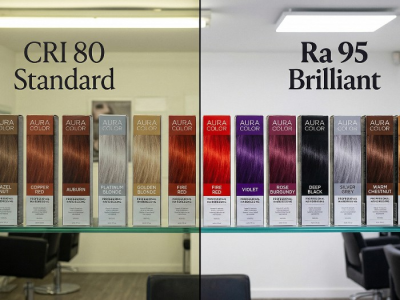



The new balayage looks absolutely perfect in the salon mirror. Then the shock: one glance in the car mirror in daylight, and that cool ash blonde suddenly looks yellow.
Moments like that cost you loyal clients — especially in a competitive market. More often than not, the problem isn't the colourist's technique. It's the salon lighting. The good news: with the right LED lighting, it's completely avoidable.
This guide explains why High-CRI lighting is the single most important tool for accurate colour results — and how to upgrade your salon the right way. Whether you're a salon owner, a colourist, or an electrician specifying a new fit-out, you'll find everything you need here.
Lighting Quality as a Competitive Advantage
In today's market, great technical skill alone isn't enough to stand out. The whole experience has to feel right — from the first consultation to the final look in the mirror before your client walks out the door.
Your lighting is your most important — and most underestimated — working tool. Good salon lighting with high colour rendering does three things at once:
- It prevents costly colour corrections caused by misleading light
- It makes your entire salon look more premium and welcoming
- It creates an environment where clients feel well-lit and attractive — and come back because of it
Salons that invest in professional High-CRI LED lighting have a clear competitive edge over those still using outdated standard lights.
Why CRI Matters for Hairdressers
CRI stands for Colour Rendering Index. It measures how accurately a light source shows colours compared to natural daylight (CRI 100). The higher the number, the truer the colours appear.
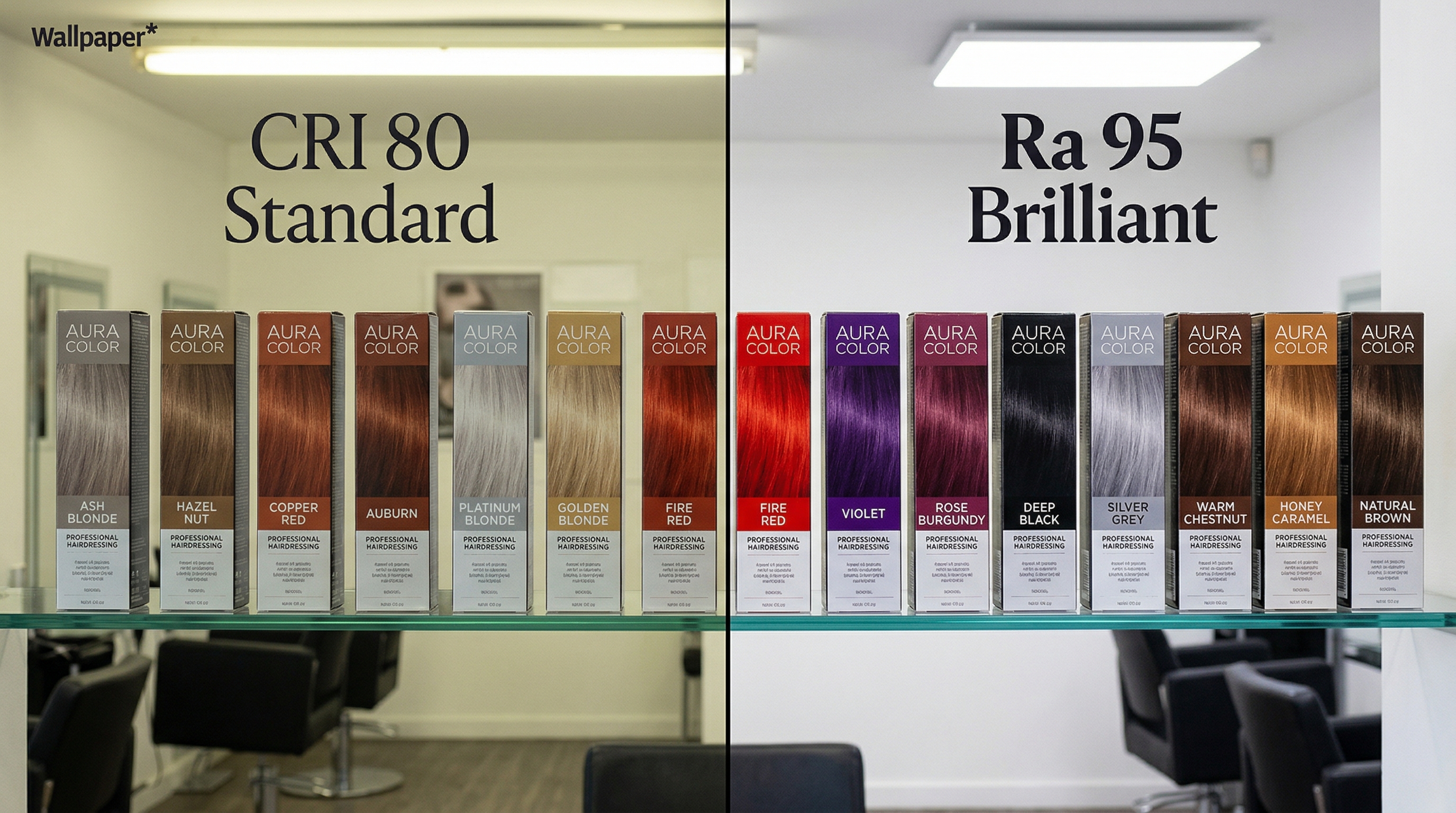
For colourists, this number is everything. When you're mixing hair colour, you're making judgements about shades that differ by tiny margins. The problem: standard LED lights often have a CRI of only 80 — meaning 20% of the colour spectrum is swallowed or distorted.
Head-to-Head: CRI 80 vs. High-CRI (>95)
Here's what the difference actually looks like in day-to-day salon work:
| Colour Situation | Standard Light (CRI 80) | Premium Light (High-CRI >95) |
|---|---|---|
| Cool Blonde Tones | Often looks yellowish; green tones go unnoticed | Ash and silver tones shown accurately |
| Reds & Copper | Looks flat, dull, and lifeless | Brilliant, rich, and multi-dimensional |
| Skin Tone | Pale, washed-out; blemishes are highlighted | Healthy, rosy, and flattering |
| Colour Mixing | High risk of mixing errors | Full control over pigmentation |
The Right Light Source for Accurate Results
To guarantee accurate colour results, you need High-CRI LED systems designed specifically for professional salon use. But CRI isn't the only thing that matters — colour temperature (measured in Kelvin) plays an equally important role.
The Daylight Trade-Off: Precision vs. Atmosphere
In theory, 6500K (daylight white) would be perfect for assessing colours as accurately as possible. In practice, it looks extremely cold, clinical, and harsh. Under full daylight white, even fine lines and shadows on a client's face are mercilessly emphasised — the complete opposite of a welcoming salon environment.
The goal is to find a smart balance between technical precision and a flattering, comfortable atmosphere.
The Optimal Colour Temperature for a Hair Salon
For cutting and colouring stations, 4000K (neutral white) has become the gold standard. It's cool enough to show hair colours accurately without a red or yellow cast — and warm enough to give skin a healthy, flattering tone.
Zone Planning: The Right Light for Every Area
A modern hair salon benefits enormously from thoughtful lighting zones. Each area of the salon has different needs — and your lighting plan should reflect that.
Colour Bar
Uncompromising precision for colour mixing. The highest CRI spec in the entire salon.
Styling Station
Gold standard: neutral white from above and in front. No unflattering shadows on the client's face.
Backwash Area
Warm, relaxing light. Anti-glare is essential — clients are looking straight up at the ceiling.
Ergonomics: Glare-Free, Flicker-Free Lighting
Lighting quality directly affects the health of your team — people who work 8 to 10 hours a day under artificial light with intense concentration.
Low-quality LEDs often produce invisible flicker. The effects build up over the course of a working day: tired eyes, headaches, and reduced concentration — all of which affect precision and performance. Glare control is just as important:
How to Spot Good Salon LEDs
Don't be misled by marketing terms like "daylight" or "natural white" on the packaging. Always check the technical datasheet — here's what to look for:
- Ra value (general CRI) >90: Non-negotiable — anything below this is unsuitable for professional colour work.
- R9 value >80 (red rendering): The standard CRI only measures 8 pastel colours. The R9 value covers saturated red. Since skin and warm hair tones contain strong red components, a high R9 is the single most important quality marker for hairdressers.
- Flicker-free: No measurable fluctuation in light output — essential for fatigue-free working over long shifts.
- UGR <19: Low glare for comfortable, focused work throughout the day.
- 4000K colour temperature: Neutral white — the gold standard for cutting and colouring.
Frequently Asked Questions About LED Lighting for Hair Salons
What CRI rating should a hair salon use?
Hair salons need a CRI of at least 90, ideally above 95. The R9 value (above 80) is especially important — it covers saturated red tones, which are critical for accurate hair colour and healthy-looking skin tones.
What colour temperature is best for a hair salon?
4000K (neutral white) is the gold standard for cutting and colouring stations. It's cool enough for accurate colour assessment and warm enough to flatter the client's skin. For the backwash area, 3000K works well — warmer and more relaxing.
What does flicker-free lighting mean and why does it matter?
Flicker-free lighting means the LED produces no invisible fluctuations in brightness. Budget LEDs often flicker, which causes eye strain, headaches, and fatigue during long working days. Flicker-free High-CRI panels are an ergonomic essential for any professional salon.
Is it worth investing in High-CRI LED panels for a hair salon?
Yes — and it pays for itself quickly. Fewer colour corrections, happier regulars, a more premium salon image, and healthier working conditions for your team. LED panels also have a very long lifespan (50,000+ hours) and low running costs.
I can find cheap lights for £35–£45. Why do professional salon LEDs cost more?
Think of it like a pair of hairdressing scissors — you buy those from a professional supplier, not a supermarket. When you work under artificial light for 8 hours a day, you quickly learn to value lighting that doesn't make your eyes ache or distort your colour work. Budget lights simply don't meet the CRI, R9, flicker, and UGR standards that professional salon use demands. The cost difference in the light is far smaller than the cost of one unhappy client.
Our Experience with Hair Salons — Since 2015
Experience & Expertise · Cologne LED · Professional Salon Lighting
We've been supplying lighting for hairdressing salons and barber shops since 2015, with a clear focus on accurate, high colour rendering. To date, we've worked with well over 100 salons — many of whom have come back to us when opening their second or third location.
During the Covid-19 closures, we helped a large number of salons use the enforced downtime to upgrade their lighting. Many owners told us it was the best investment they made during that period.
We don't sell designer lighting. What we do offer are reliable, highly colour-accurate panels that produce comfortable, activating light — appreciated by owners and staff alike. At prices that make commercial sense and return on investment you can actually measure.
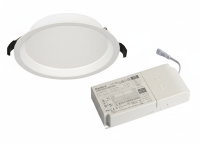
Upgrade Your Salon Now
Don't leave your colour results to chance. Investing in High-CRI LED lighting is a direct investment in client satisfaction, fewer colour corrections, and a healthier workplace for your team.
View High-CRI LED Panels Request a Lighting Consultation