200W LED hall lighting
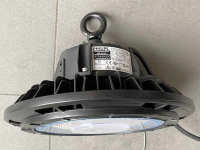
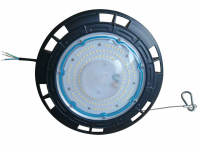


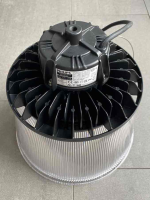
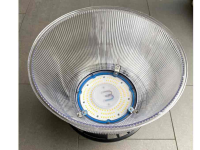
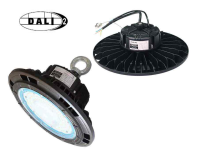
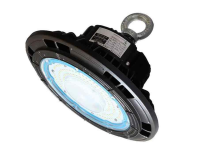
200-watt LED high bays
The class for tall halls and plenty of light. Typical applications are ceilings of around 7 to 8 metres, assembly, production at 300 lux and sales floors. From about 8 metres, the beam angle should be narrower, otherwise too little light reaches the floor. That is what narrow-beam high bays with 60 to 90 degrees are for.
- Ceiling height
- around 7 to 8 m
- Luminous flux
- 29,000 to 40,000 lm
- Replaces
- 400 W mercury vapour or metal halide, or older LED of about 330 W
- Typical use
- high halls, assembly, sales floors
When it pays to replace
Not everyone who calls us still has old discharge lamps on the ceiling. Just as often, it's LED high bays that simply aren't doing their job any more.
LED high bays from 2012 to 2016
The first generation of LED high bays now has ten years of continuous operation behind it. The first fittings are starting to fail, and in a tall hall every single replacement means hiring a lift.
Older LED that still works
The lights still work but have grown dimmer over the years. They manage 100 to 120 lumens per watt. New high bays with 200 lm/W bring back full light output and use around 40 per cent less power as well.
Cheap high bays that fail early
Budget high bays bought online often can't cope with 8 to 10 hours of operation a day. We regularly see them fail after about six months, and the driver is usually to blame.
Mercury vapour and metal halide
A 400-watt fitting draws around 450 watts including its ballast. A 200-watt LED high bay needs less than half of that. Where the old 400-watt fittings were too dim, this is the right class.
To see what the switch would save in your hall and how quickly it pays for itself, including installation, use the payback calculator in our guide to LED high bay lighting.
How much light you get from 200 watts
| Efficacy | Luminous flux at 200 W | Typical of |
|---|---|---|
| 110 lm/W | 22,000 lm | older LED, around 2012 to 2016 |
| 145 to 190 lm/W | 29,000 to 38,000 lm | today's market average |
| 200 lm/W | 40,000 lm | efficient current models |
More power doesn't automatically light a hall better, though. A few very bright fittings create bright islands beneath them and dark zones in between. So the rule is: use 200 watts where the height calls for it, not as a shortcut to fewer fittings in low halls.
How many high bays you need
Production hall
- Required
- about 304,000 lm
- at 29,000 lm per fitting
- 11 to 13 high bays
- at 40,000 lm per fitting
- 8 to 9 high bays
Rule of thumb
Multiply the illuminance in lux by the floor area in m² and divide by the utilisation factor of the installation (roughly 0.6 to 0.8). That gives the luminous flux you need. Divide it by the lumens of one fitting. For ceilings above 5 metres, add 20 to 30 per cent.
Calculated with some headroom for ageing and dust. You will find more examples and the lux levels by task in our guide to LED high bay lighting.
What to look for when buying
- Efficacy. Between 150 and 200 lm/W there are 10,000 lumens per fitting. Across 20 high bays, that is 200,000 lumens, as much light as five extra fittings.
- The beam angle. 90 degrees works up to about 8 metres, above that 60 degrees is usually better. Ask whether other optics are available.
- A branded driver and IP65. Large fittings run warm and often hang where they are hard to reach. With us, a five-year warranty is practically the norm.
- The right dimming. 0–10 V or power settings on the housing let you match the brightness to the hall. For control by zone, presence or daylight, choose a DALI luminaire.
If it doesn't meet our standards, we don't sell it.
Current model and clearance
At the top of this category you will find our current model, the UFO high bay with 200 lm/W and a Philips driver, alongside older models while stocks last. All power classes are listed in our LED high bay overview.
Frequently asked questions
At what ceiling height do I need 200 watts?
Usually from about 7 metres, or when 300 lux and more are required. In lower halls, more fittings at 150 watts often give more even light.
Will a 200-watt high bay work above 8 metres?
With a 90-degree beam, it gets tight. Above 8 metres, narrow-beam high bays with 60 degrees are the better choice, so that enough light reaches the floor.
Our LED high bays are ten years old. Is it worth replacing them?
Usually yes, even if they still work. Older LED high bays manage 100 to 120 lm/W and have grown dimmer over the years. A current model with 200 lm/W brings back full light output and uses around 40 per cent less power.
Planning a tall hall?
Give us a quick call. We'll sort it out in five minutes.
- Personal advice, easy to reach
- Highly reliable products
- Experience with halls since 2014